
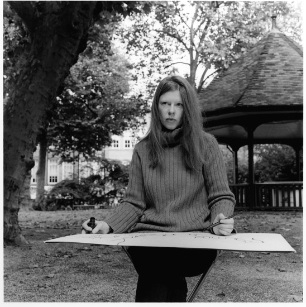
Drawing Out Ideas by Neil Churcher
Design Week 12 September 2002.
'We all went to art school because at one point we could draw' says illustrator and tutor at the Royal College of Art, Marion Deuchars. 'Then somewhere along the line, some of us stop'. Deuchars is alluding to a certain kind of drawing that is the raw material of the sketchbook. That live, on the spot recording of a scene or the capture of an interesting moment or character. Sketchbook drawing was traditionally evidence that a designer was visually informed. A fat sketchbook was proof of design skill as well as productivity. But such practices no longer seem to be at the forefront of designer's interests. Computer led design has literally eroded away its importance and replaced it with the values of digital visualization. No salvation rests with illustration because here, drawing is on the whole a tool to help visualize constructed ideas rather than completed as an end in itself. If drawing's prowess has diminished, I wanted investigate where it had gone. I found that it still survives more as a subculture and when exposed, can be the topic of strong values and still churn up gripping work.
The house of illustrator and self confessed 'drawer' Lucinda Rogers is literally full of drawings. Sketches and framed works are crammed into every available space. Lucinda is unusual because she both exhibits drawings and illustrates on commission. Her last exhibition at the OXO Gallery in London contained a series of drawings of New York and London including work made directly after the events of September 11. 'I am an illustrator but I tend to differentiate between illustrations and drawings,' says Rogers, 'because I draw off my own bat as well as to commission. The term illustration is slightly confining for these works. Drawings for their own sake, exhibited and bought by somebody off the wall, are not commercial illustration and I tend to use the term drawings.' Rogers studied illustration at (the then) St Martins School of Art and soon after started getting commissions for reportage-style illustration work. 'I used to illustrate a travel page in the Independent on Sunday, says Rogers. 'But I couldn't go to Istanbul or Delhi so I had to fabricate an illustration using reference material. I eventually felt I wanted to do real reportage and work directly from life. I asked the Independent's art director Joe Dale if she would send me somewhere'. Dale came up with a series on British chefs. 'I had to go around the country drawing nine different chefs in their kitchens and restaurants and that's how I started reportage.'
Reportage allowed Rogers to consolidate her 'on the spot' drawing with her illustration work. The two became one. However she continued to work 'non-commissioned' especially during annual drawing trips to New York. This led to a series of drawings completed in the aftermath of September 11th which has given her non-commissioned work a whole new dimension. 'If you stare at a place for a long time, you remember tiny things about it, you feel quite intimate with the place,' says Rogers who has been drawing there since 1988. 'It's like knowing someone's face really well. When September 11th happened I felt the physical effect and at some level I wanted to draw it, or draw something to do with what had happened to the city, its loss. I didn't know what I was going to do but felt that I had been representing the place for so long that I must somehow represent this event.' A friend who was working at the ground zero site suggested she came with her to do some drawings there. 'I never had official permission but everyone seemed quite happy about it,' she says. 'They had an extreme policy which outlawed photography anywhere on the site but drawing wasn't seen in the same way. They didn't want any kind of sensationalism and maybe there is something quiet and old-fashioned about drawing that seemed to go along with the basic raw task at ground zero'.
Lucinda witnessed the removal of wreckage and the work of the morgue where any findings of bodies or body parts were recorded in an ominously large book, the atmosphere set to a backdrop of tired volunteer workers, firemen and emergency services personnel. 'I didn't know what to do with the drawings,' says Rogers. 'I knew that they should represent a form of record and be kept together. It's the sort of reportage that I'd like to do again.' All Rogers' drawings have the strength to produce a tangible impression of the subject. The ground zero drawings, though, seem to work on another level perhaps because the subject is greater than any everyday experience. It's also because they record moments of intense concentration by the drawer. Rogers remembers the adrenaline rush that enabled her to work wide awake at 4am, because the subject was constantly compelling.
When discussing these issues with Marion Deuchars while looking over a series of her sketchbooks, the kind of work not usually shown to the public, the subject centers around the process of drawing, a subject Deuchars seems fascinated with. 'It's just honesty,' says Deuchars. 'It's not about applying any logic to it apart from looking and editing what you're drawing. It's a slightly subconscious process. You're doing this for yourself, you're not thinking how its going to be interpreted. As an illustration you would think how is that going to be perceived or how will it be understood? We look one of her drawings of a market seller displaying his wares on a sheet on the ground that Deuchars sketched in Cuba. It is a recording that Deuchars used later to create an illustration featuring objects on display. The illustration is a distillation of the sketch. The illustration is visually balanced and interesting but the sketch somehow seems to have more elements to the story. It seems to retain more. It's a good example of how drawing informs illustration and also design but doesn't seem to explain what gets lost in the process. Deuchars suggests that this is because the process itself is different from design, closer to a less-considered form of creating things, a rawness that any design process may eradicate. 'It's directly eye to hand,' says Deuchars. 'When you start a drawing, you have no idea whether it's good until it's finished. You have to let it go on its own journey. What you have to do is to start it without thinking, like reading a book and finishing it'.
Phil Carter of Carter Wong Tomlin is another sketchbook drawer. As a graphic designer, Carter's sketchbook work is potentially further separated from his everyday work but Carter insists that the symbiosis between sketching and design is strong. 'I draw a lot while I'm away and also draw on a daily basis,' says Carter. 'I stop off at the Serpentine in Hyde Park on my way to work and draw. It's a good way to start off the day and even end it. Again, a back to basics drawing process seems to generate an underlying worth that Carter values. 'I like to photograph and draw as it keeps me visually aware' says Carter, 'and I think design is difficult if you're not visually aware. Drawing says a lot more than capturing ideas in other ways on a lot of occasions'. The drawing ethic allows Carter to relate design process to craft, something that he suggests is threaded though the company. 'Drawing is a skill that is sadly being lost and it's an element of craft that is very important'. He says. 'We look to people that draw. I always ask students if they have sketchbooks as we like people that are informed by drawing.' It is a value that Carter suggests crosses over to clients. 'We present very rough drawn visuals to clients rather than finished looking computer visuals, because clients don't feel so threatened by them.'
Even if such drawing has been reduced to subcult rather than prime skillbase, I don't fear that drawing skills will disappear altogether. Certainly Rogers' recent work for GTF and Scarlet Productions for Bloomberg and Deuchars work drawing the D&AD review for Vince Frost, shows how drawing can be used as design in itself. Drawing suddenly seems to be a flipside of computer generated design and therefore more and more valid as an alternative. Importantly, I think all designers appreciate and feel a bond with the drawings they see. In fact we have all had a hand in drawing, as children and even older, drawing is as intrinsic to learning as math or playing the recorder and you can't remove that.
← Back to Biography